Things everybody “knows” about Velociraptor
Most of them came from one very good film.
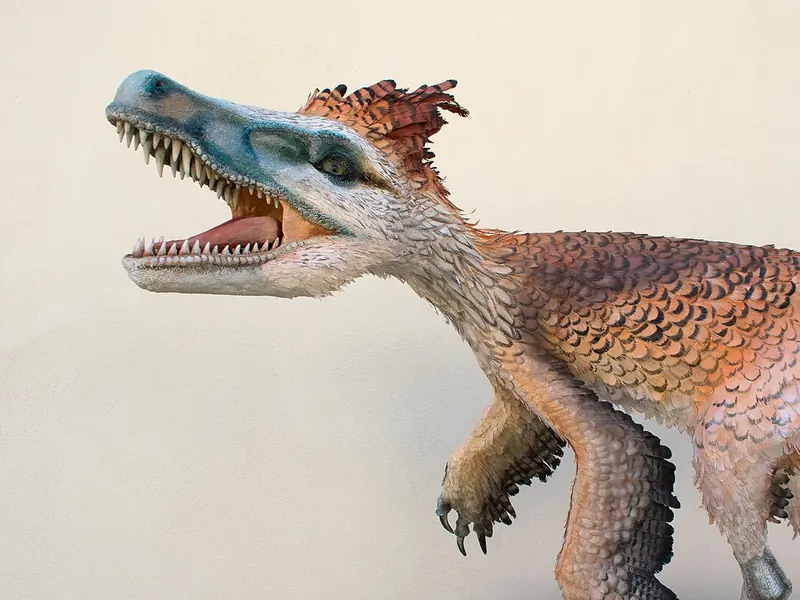
Myth Velociraptor was as tall as a person.
Fact The Natural History Museum calls it a turkey-sized predator. Natural History Museum: Vicious Velociraptor: tales of a turkey-sized dinosaur Next to a grown-up, it would have been no more than waist-high. Smithsonian Magazine: You say “Velociraptor,” I say “Deinonychus”
Myth It was covered in scales.
Fact In 2007, quill knobs on a Velociraptor fossil proved it had long feathers, attached from its second finger and up its arms. Natural History Museum: Vicious Velociraptor: tales of a turkey-sized dinosaur The Natural History Museum’s Susie Maidment says the biggest mistake now is that the film raptors are naked: “It’s absolutely certain that they would have been covered in feathers.” Natural History Museum: Debunking dinosaur myths and movie misconceptions · checked 28 Oct 2026
Myth Its claw sliced prey open.
Fact A mechanical model of the claw, built for the BBC documentary The Truth About Killer Dinosaurs, couldn’t disembowel anything. Natural History Museum: Vicious Velociraptor: tales of a turkey-sized dinosaur The scientists behind it built a hydraulic leg to the dimensions of Velociraptor and Deinonychus. Its claw made small, round puncture wounds 30 to 40 mm deep, and never slashed. Manning, Payne, Pennicott, Barrett & Ennos (2006), Dinosaur killer claws or climbing crampons?, Biology Letters
Myth It tapped its claw while it waited.
Fact No evidence of claw tapping has ever been found. Tracks of Velociraptor’s relatives show no marks from the sickle claw. Natural History Museum: Vicious Velociraptor: tales of a turkey-sized dinosaur
Myth It was smarter than humans.
Fact There’s an urban myth that Velociraptor scores higher than humans on brain-to-body size. It clearly doesn’t. Natural History Museum: Vicious Velociraptor: tales of a turkey-sized dinosaur Its brain was large for its body compared with most reptiles. Button: smart “like an average bird – a hawk or something like that”, not like a chimp, a parrot or a crow. Natural History Museum: Vicious Velociraptor: tales of a turkey-sized dinosaur · checked 28 Oct 2026
Myth It hunted in packs.
Fact Despite the films, there’s very little evidence that raptors hunted as cooperative packs. Natural History Museum: Vicious Velociraptor: tales of a turkey-sized dinosaur · checked 28 Oct 2026 There isn’t currently any evidence of Velociraptor hunting together in any way, though that doesn’t mean it never did. Natural History Museum: Vicious Velociraptor: tales of a turkey-sized dinosaur · checked 28 Oct 2026
Myth It could fly.
Fact It couldn’t fly. Its wishbone wasn’t the right shape for flapping wings, its wings were too small to glide, and its feathers were symmetrical, unlike a flying bird’s. Natural History Museum: Vicious Velociraptor: tales of a turkey-sized dinosaur
Myth It lived in the Jurassic.
Fact The Natural History Museum dates it to the Late Cretaceous, 74 to 70 million years ago. Natural History Museum: Velociraptor (Dino Directory) · checked 28 Oct 2026
Myth It regularly hunted big dinosaurs.
Fact It probably ate mostly small mammals and reptiles that were easy to overpower and kill. Natural History Museum: Vicious Velociraptor: tales of a turkey-sized dinosaur Despite the famous fossil, it seems very unlikely that Velociraptor regularly hunted grown-up Protoceratops. Natural History Museum: Vicious Velociraptor: tales of a turkey-sized dinosaur
Myth “Raptor” is the scientific name for the group.
Fact “Raptor” isn’t a proper scientific term. Scientists say dromaeosaurs: small to medium-sized hunters with large toe claws. Natural History Museum: Deinonychus (Dino Directory)
Myth Oviraptor stole other dinosaurs’ eggs.
Fact In the 1990s, museum expeditions found identical eggs, one holding the embryo of an Oviraptor-like dinosaur. Oviraptor was a parent, not an egg thief. American Museum of Natural History: Dinosaur Eggs Osborn himself warned the name “may entirely mislead us as to its feeding habits”. Osborn (1924), Three new Theropoda, Protoceratops zone, central Mongolia, American Museum Novitates 144