The claw, the feathers and the bird inside
A turkey-sized body, a long stiff tail, feathered arms, and one very famous toe.
The famous claw
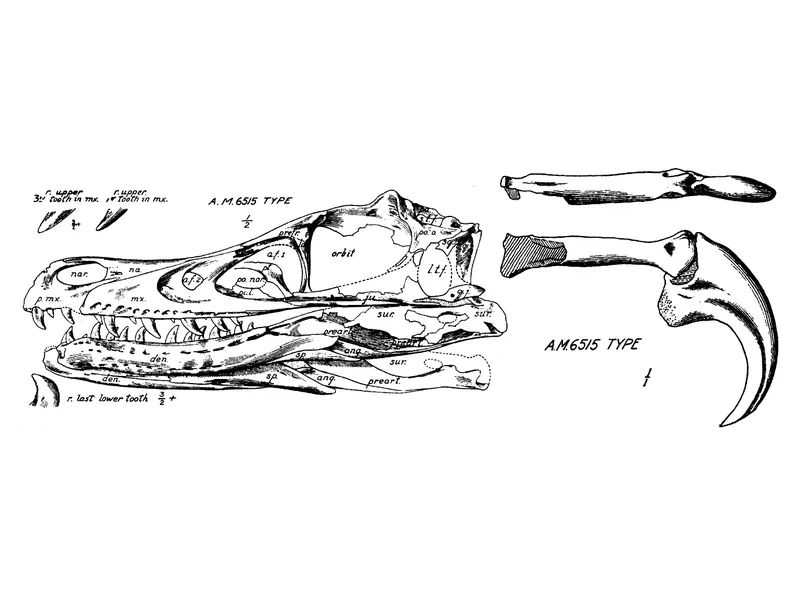
The famous curved claw sits on the second toe of each foot. Natural History Museum: Vicious Velociraptor: tales of a turkey-sized dinosaur The claw could grow to more than 6.5 cm around its outer edge. Natural History Museum: Vicious Velociraptor: tales of a turkey-sized dinosaur
In life, a horny sheath covered the toe and finger bones, which would have made the claws about twice the size of the bones you see. American Museum of Natural History: Get to Know a Dino: Velociraptor, 2016
Theropods usually had three toes on each foot. Natural History Museum: Vicious Velociraptor: tales of a turkey-sized dinosaur Velociraptor walked on two toes and held the sickle claw up off the ground, presumably to keep it sharp. Natural History Museum: Vicious Velociraptor: tales of a turkey-sized dinosaur
Hand or foot?
Osborn assumed the big curved claw came from the hand. Natural History Museum: Vicious Velociraptor: tales of a turkey-sized dinosaur In his 1924 paper he wrote that the claw bones “probably belong to the enlarged Digit I of the manus”: the first finger. Osborn (1924), Three new Theropoda, Protoceratops zone, central Mongolia, American Museum Novitates 144
Stabbing, not slashing
A mechanical model of the claw, built for the BBC documentary The Truth About Killer Dinosaurs, couldn’t disembowel anything. Natural History Museum: Vicious Velociraptor: tales of a turkey-sized dinosaur The scientists behind it built a hydraulic leg to the dimensions of Velociraptor and Deinonychus. Its claw made small, round puncture wounds 30 to 40 mm deep, and never slashed. Manning, Payne, Pennicott, Barrett & Ennos (2006), Dinosaur killer claws or climbing crampons?, Biology Letters
They concluded the claws gripped the hides of prey many times larger than the raptor, like climbing crampons. Manning, Payne, Pennicott, Barrett & Ennos (2006), Dinosaur killer claws or climbing crampons?, Biology Letters Research suggests the claw was for stabbing, not slashing, and was probably used as a hook to stop prey escaping. Natural History Museum: Vicious Velociraptor: tales of a turkey-sized dinosaur
A land eagle
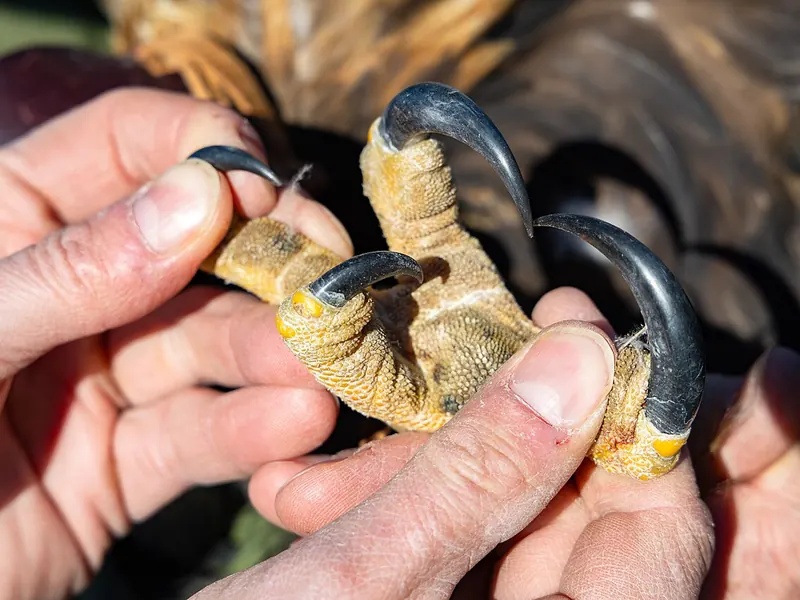
Button: “If you look at the claw it looks just like the talon of an eagle, which is used to grip prey and pin it down.” Natural History Museum: Vicious Velociraptor: tales of a turkey-sized dinosaur Button suggests thinking of Velociraptor as a “land eagle”. Natural History Museum: Vicious Velociraptor: tales of a turkey-sized dinosaur
A 2011 study suggested the claw worked like the big talon on the second toe of hawks and eagles, holding prey pinned under the predator’s weight. Fowler, Freedman, Scannella & Kambic (2011), The predatory ecology of Deinonychus and the origin of flapping in birds, PLOS ONE The same study described “stability flapping”: flapping the feathered arms to stay balanced on top of struggling prey. Fowler, Freedman, Scannella & Kambic (2011), The predatory ecology of Deinonychus and the origin of flapping in birds, PLOS ONE
It also suggested that this grasping foot later helped birds perch in trees. Fowler, Freedman, Scannella & Kambic (2011), The predatory ecology of Deinonychus and the origin of flapping in birds, PLOS ONE
Feathers
In 2007, quill knobs on a Velociraptor fossil proved it had long feathers, attached from its second finger and up its arms. Natural History Museum: Vicious Velociraptor: tales of a turkey-sized dinosaur Scientists found six quill knobs, the bumps where feathers anchor to bone, on a Velociraptor forearm dug up in Mongolia in 1998. American Museum of Natural History: Velociraptor Had Feathers, Study Confirms, 2007
The study was by palaeontologists at the American Museum of Natural History and the Field Museum, and appeared in the journal Science. American Museum of Natural History: Velociraptor Had Feathers, Study Confirms, 2007 Living birds have quill knobs too. They show most clearly in strong fliers. American Museum of Natural History: Velociraptor Had Feathers, Study Confirms, 2007
As the study’s lead author put it, a lack of quill knobs doesn’t necessarily mean a dinosaur had no feathers. American Museum of Natural History: Velociraptor Had Feathers, Study Confirms, 2007 Close relatives, including Microraptor and Zhenyuanlong, have been found with their feathers preserved. Natural History Museum: Vicious Velociraptor: tales of a turkey-sized dinosaur
Velociraptor was covered in thin filaments, and the feathers on its tail and forearms would look right at home on a living bird. American Museum of Natural History: Get to Know a Dino: Velociraptor, 2016
But it couldn’t fly
It couldn’t fly. Its wishbone wasn’t the right shape for flapping wings, its wings were too small to glide, and its feathers were symmetrical, unlike a flying bird’s. Natural History Museum: Vicious Velociraptor: tales of a turkey-sized dinosaur The 2007 study’s authors suggested that an ancestor of Velociraptor may have lost the ability to fly but kept its feathers. American Museum of Natural History: Velociraptor Had Feathers, Study Confirms, 2007
The feathers may have been for display, for shielding nests, for keeping warm, or for help with turning while running. American Museum of Natural History: Velociraptor Had Feathers, Study Confirms, 2007 There is quite good evidence that dromaeosaurs ran warm, and feathers would have kept that heat in. Natural History Museum: Vicious Velociraptor: tales of a turkey-sized dinosaur
A very unusual bird
Mark Norell, a curator at the American Museum of Natural History and co-author of the 2007 study: “If animals like Velociraptor were alive today our first impression would be that they were just very unusual looking birds.” American Museum of Natural History: Velociraptor Had Feathers, Study Confirms, 2007 Its bird-like features include hinged ankles, swivel-jointed wrists and a wishbone. American Museum of Natural History: Get to Know a Dino: Velociraptor, 2016
Meet one today and it might look like a stretched-out bird of prey with a very long tail, clawed hands and teeth instead of a beak. Natural History Museum: Vicious Velociraptor: tales of a turkey-sized dinosaur Like living birds and reptiles, it had a ring of bone in each eye socket. American Museum of Natural History: Get to Know a Dino: Velociraptor, 2016
Strictly speaking, all birds are dinosaurs. But not all dinosaurs are birds. Natural History Museum: Archaeopteryx (Dino Directory)
How big?
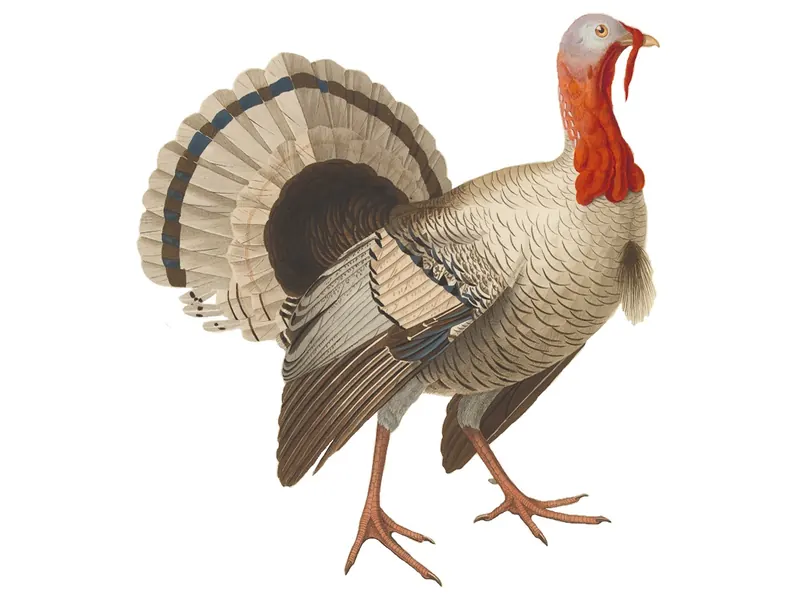
The Natural History Museum gives its length as 1.8 m and its weight as 7 kg. Natural History Museum: Velociraptor (Dino Directory) · checked 28 Oct 2026 The Natural History Museum calls it a turkey-sized predator. Natural History Museum: Vicious Velociraptor: tales of a turkey-sized dinosaur
The Velociraptor in the 2007 feather study stood about three feet (0.9 m) tall, was about five feet (1.5 m) long and weighed about 30 pounds (14 kg). American Museum of Natural History: Velociraptor Had Feathers, Study Confirms, 2007 · checked 28 Oct 2026 Next to a grown-up, it would have been no more than waist-high. Smithsonian Magazine: You say “Velociraptor,” I say “Deinonychus”
Lengths, weights and dates for Velociraptor are estimates from fossils, and the museums don’t all agree. The Natural History Museum gives 1.8 m and 7 kg; the American Museum of Natural History’s 2007 feather study described an animal about 1.5 m long and about 30 pounds (14 kg). The Natural History Museum dates it to 74 to 70 million years ago; an American Museum of Natural History card dates the Fighting Dinosaurs to about 80 million. Each figure links to who said it and the date we checked. See open questions for the disagreements side by side.
Next: how it lived →